

How To Calculate Proportionality Constant
Constant of Proportionality
When two variables are directly or indirectly proportional to each other, and then their relationship can be described as y = kx or y = thou/10, where g determines how the two variables are related to i another. This k is known as the constant of proportionality.
| 1. | What is Constant of Proportionality? |
| 2. | Why Do Nosotros Apply The Constant of Proportionality? |
| 3. | How to Solve The Constant of Proportionality? |
| 4. | Identifying The Constant of Proportionality |
| 5. | Solved Examples |
| 6. | Do Questions |
| seven. | FAQs on The Abiding of Proportionality |
What is Constant of Proportionality?
Abiding of proportionality is the constant value of the ratio betwixt two proportional quantities. Two varying quantities are said to exist in a relation of proportionality when, either their ratio or their production yields a constant. The value of the constant of proportionality depends on the type of proportion between the ii given quantities: Direct Variation and Inverse Variation.
- Direct Variation: The equation for direct proportionality is y = kx, which shows equally x increases, y besides increases at the same rate. Example: The toll per item(y) is straight proportional to the number of items(x) purchased, expressed every bit y ∝ ten
- Inverse Variation: The equation for the indirect proportionality is y = k/x, which shows that as y increases, ten decreases and vice-versa. Example:The speed of a moving vehicle (y) inversely varies as the time taken (x) to cover a sure distance, expressed as y ∝ i/ten
In both the cases, yard is abiding. The value of this constant is chosen the coefficient of proportionality. The constant of proportionality is also known as unit charge per unit.

Why Do Nosotros Utilise The Abiding of Proportionality?
We use abiding of proportionality in mathematics to calculate the rate of modify and at the same time determine if it is straight variation or changed variation that we are dealing with. Permit us assume that the cost of 2 apples = $20. We decide that the price of 1 apple = $10. Nosotros have found the Constant of Proportionality for the cost of an apple tree is 2.
If we want to draw a flick of the Taj Mahal by sitting in front of it on a piece of paper by looking at the real prototype in front of u.s.a., we should maintain a proportional relationship between the measures of length, top, and width of the building. We demand to identify the abiding of proportionality to become the desired outcome. Based on this, we tin depict the monument with proportional measurements. For instance, if the height of the dome is 2 meters so in our cartoon we can correspond the same dome with acme two inches. Similarly, we tin can draw other parts. In such scenarios, we use abiding of proportionality.
Working with proportional relationships allows i to solve many real-life problems such as:
- Adjusting a recipe's ratio of ingredients
- Quantifying take chances similar finding odds and probability of events
- Scaling a diagram for drafting and architectural uses
- Finding percent increment or percent decrease for price mark-ups
- Discounts on products based on unit charge per unit
How to Solve The Constant of Proportionality?
We apply our knowledge on the direct and inverse variations, identify them and then decide the constant of proportionality and thereby become the solutions to our bug.
Example ane:Find the abiding of proportionality, if y=24 and 10=3 and y ∝ x.
Solution: We know that y varies proportionally with x. We can write the equation of the proportional relationship as y = kx. Substitute the given ten and y values, and solve for k.
24 = k (3)
k = 24 ÷ three = viii
Therefore, the constant of proportionality is 8.
Example 2: 4 workers accept 3 hours to finish the desired work. If two more workers are hired, in how much time volition they complete the work?
Solution: Allow x1 = number of workers in case 1 = 4
x2 = Number of workers in example ii = 6
y1 = number of hours in example 1 = iii
y2 = number of hours in example 2 = To be institute
If the number of workers is increased, the time taken to consummate will reduce. We find that number of workers is inversely proportional to the fourth dimension taken, (y1 = yard/x1) ⇒ 3 = 1000 / 4⇒ k = 12
Once again, to find the number of hours, (y2 = one thousand/x2) ⇒ y2 = 12/six= 2 hours.
Identifying The Abiding of Proportionality
We shall now acquire how to identify the constant of proportionality (unit charge per unit) in tables or graphs. Examine the table beneath and determine if the relationship is proportional and find the constant of proportionality.
| Number of Days = 10 | 1 | three | 5 | half dozen |
|---|---|---|---|---|
| Number of Manufactures Written = y | 3 | 9 | xv | xviii |
Nosotros infer that equally the number of days increases, the ariticles written also increases. Here we identify that it is in straight proportion. We apply the equation y= kx. To find the abiding of proportionality we determine the ratio betwixt the number of manufactures and the number of days. We need to evaluate for k = y/x
y/x = 3/i = 9/3 = fifteen/5 = eighteen/half dozen = 3
From the result of the ratios of y and 10 for the given values, we can observe that the same value is obtained for all the instances. TheAbiding of Proportionality is 3.
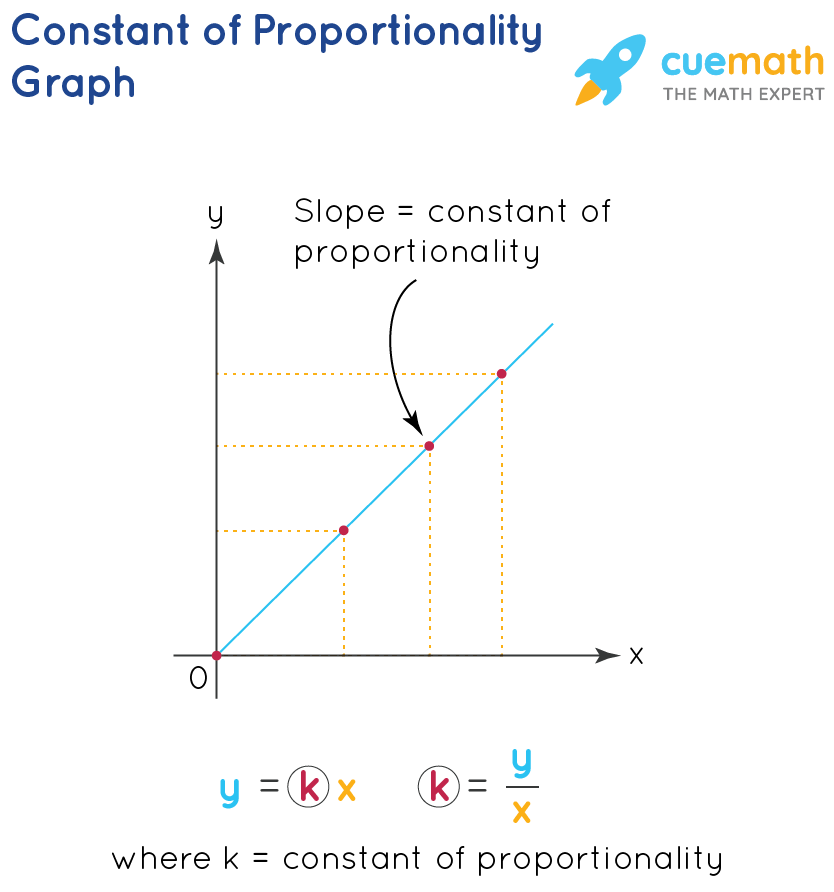
If we plot the values from the to a higher place table onto a graph, we detect that the directly line that passes through the origin shows a proportional relationship. The constant of proportionality under the direct proportion condition is the slope of the line when plotted for two proportional constants x and y on a graph.
Related topics to Constant Of Proportionality
- Inverse Proportion Formula
- Straight Proportion Formula
- Constant of proportionality Reckoner
Important notes
- To check if the 2 quantities are proportional or not, we have to find the ratio of the two quantities for all the given values. If their ratios are equal, and then they exhibit a proportional relationship. If all the ratios are not equal, then the relation between them is non proportional.
- If ii quantities are proportional to one another, the human relationship between them can exist defined byy = kx, where 1000 is the constant ratio of y-values to corresponding 10-values.
- The aforementioned relationship tin can also be defined past the formula ten=(1/yard)y, where one/k is at present the constant ratio of 10-values to y-values.
go to slidego to slidego to slide

How can your child main math concepts?
Math mastery comes with practise and understanding the 'Why' behind the 'What.' Feel the Cuemath difference.
Book a Free Trial Class
FAQs on Constant of Proportionality
What is the Other Name for the Constant of Proportionality?
Another name for the abiding of proportionality in mathematics is the unit rate.
What is the Constant of Proportionality in a Graph?
The straight line that passes through the origin is the constant of proportionality in a graph.
Why do we Apply Constant of Proportionality?
We utilise constant of proportionality in mathematics to determine the nature of proportionality, whether it is direct proportion or indirect proportion. The constant of proportionality helps in solving the equations involving ratios and proportions.
What is the Constant of Proportionality of 12/vi?
To find the constant of proportionality, in the case of direct proportionality, nosotros employ k=y/x. Let us have y = 12 and 10 = 6, then k = 12/half dozen = 2.
What is the Abiding of Proportionality?
If the ratio of one variable to the other is constant, and then the two variables have a proportional relationship, If x and y have a proportional relationship, the constant of proportionality is the ratio of y to ten. Sometimes, we as well represent information technology as x is to y.

How To Calculate Proportionality Constant,
Source: https://www.cuemath.com/commercial-math/constant-of-proportionality/
Posted by: bellwased1993.blogspot.com
0 Response to "How To Calculate Proportionality Constant"
Post a Comment