

Academic And Domain Specific Vocabulary
Teaching Academic and Discipline-Specific Vocabulary
Excerpt from Transformational Literacy
The best vocabulary learning is contextualized—students learn related sets of words from reading, listening, talking, and writing about topics and concepts. The more vocabulary a pupil is exposed to during learning, the more likely it is for that pupil to go a better reader.
Researchers concur that a vocabulary deficiency is one of the primary causes of the achievement gap. It seems obvious that students who know more than words are better able to comprehend texts and disciplinary content, yet most schools do not accept a systematic focus on didactics vocabulary (National Governors Clan Center for All-time Practices, Council of Chief Land School Officers, 2010, appendix A, p. 32). The all-time vocabulary learning is contextualized—students learn related sets of words from reading, listening, talking, and writing about topics and concepts. The more vocabulary a educatee is exposed to during learning, the more likely it is for that educatee to become a meliorate reader. Conversely, the better a student is at reading, the more likely it is for him or her to learn vocabulary.
Isabel l. Beck, Margaret G. McKeown, and Linda Kucan (2013) describe three tiers of vocabulary words. In the first tier are the words establish in everyday spoken language and commonly learned through conversations and in schoolhouse in early grades (eastward.1000., friend, nice, winter, community). Unless a student is an English language linguistic communication learner, information technology is unlikely that instruction in tier‐one words is needed.
In the second tier are the words most frequently found in texts, specially academic texts of all types (e.g., relative, vary, formulate, calibrate). These words, likewise known as academic vocabulary, are much less likely to be institute in everyday speech communication, fifty-fifty the speech of college‐educated adults. Helping students larn this type of vocabulary is critical to college and career readiness.
In the third tier are the subject‐specific words virtually oft en found in informational passages rather than in literature. They are specific to a subject field (e.chiliad., morphology, acropolis, ventricles) and key to understanding a new concept within the text. Because of their specificity, tier‐three words are oftentimes explicitly defined in text and repeatedly used. Students tend to learn these words when studying a item topic, just their utility is somewhat limited. They are highly relevant to the learning at hand, simply they aren't often transferrable to the side by side unit or text.
Three Tiers of Vocabulary
Tier Ane: Basic Vocabulary
- Words institute in everyday speech that rarely demand didactics
Tier Two: Academic Vocabulary
- Loftier‐frequency words that are found in academic texts across a variety of domains but that are unlikely to occur in everyday speech communication
Tier 3: Discipline-Specific Vocabulary
- Low‐frequency words specific to a particular bailiwick and often institute in advisory texts virtually that subject
It is simple to recognize the importance of teaching subject field‐related vocabulary while reflecting on a item topic of written report. For case, a teacher helping students grapple with the importance of protecting a watershed knows that students need to know and be able to employ science words such as habitat. Simply what is less articulate and more primal to educatee development is the need to address the academic vocabulary plant in watershed‐related texts. Consider the following brusque passage from the website of the nonprofit organization The Center for Watershed Protection:
During the land development procedure, forests are cleared, soils are compacted, natural drainage patterns are altered, and impervious surfaces, such equally roads, buildings, and parking lots, are created. These changes increase the corporeality of polluted runoff that reaches our local waterways. As a result, stream banks begin to erode, disquisitional in‐stream habitats are washed away or filled in with sediment, downstream flooding increases, and water becomes likewise polluted to support sensitive fish and bugs or recreational activities. (Centre for Watershed Protection, nd)
To fully comprehend this passage, students must know the contextualized pregnant of the words altered, impervious, and sensitive. (Certainly the author of this passage does not mean to advise the fish are crying!) Therefore, the Mutual Cadre emphasizes the teaching of tier‐two (academic) vocabulary in addition to tier‐three (discipline‐specific) vocabulary.
Vocabulary learning can be incidental—the result of reading closely, using morphology, using context clues, and writing about and discussing complex texts—or information technology tin can be explicitly taught. Both are valuable in terms of addressing students' vocabulary development needs.
Back up Incidental Vocabulary Learning
Incidental vocabulary instruction occurs when tuned‐in readers notice new words and words used in new means. The give-and-take sensitive in the watershed passage might be learned incidentally when a reader stops to think, "Huh? Sensitive? Do fish accept their feelings easily hurt? It must mean something else here, like their bodies tin't stand the pollution." Incidental vocabulary learning tin as well occur when teachers support the utilise of word‐solving techniques to assistance readers notice new words or words used in new ways. For instance, when reading the watershed passage with a class, a teacher might inquire, "Did you run into the word impervious used to draw roads, buildings, and parking lots? I know the prefix im‐ means not, and then not pervious. If I told you the root discussion pervious comes from the Latin for through, could you lot use the context of roads, buildings, and parking lots to figure out what impervious means?"
A steady diet of incidental vocabulary learning can occur when teachers help students read and reread challenging texts, and information technology is an efficient manner to ensure students larn more bookish vocabulary than they already know.
Teach Some Vocabulary with Straight Instruction
Direct vocabulary instruction occurs when teachers use strategies and protocols, such every bit Interactive Word Walls (see "Strategy Close Up: Interactive Word Wall" for more data), vocabulary notebooks or journals, Frayer model graphic organizers (run across figure vii.2), concept definition maps, drawing or acting out words, flash-cards, and other discussion exploration and storage techniques to help learners understand and remember new words.
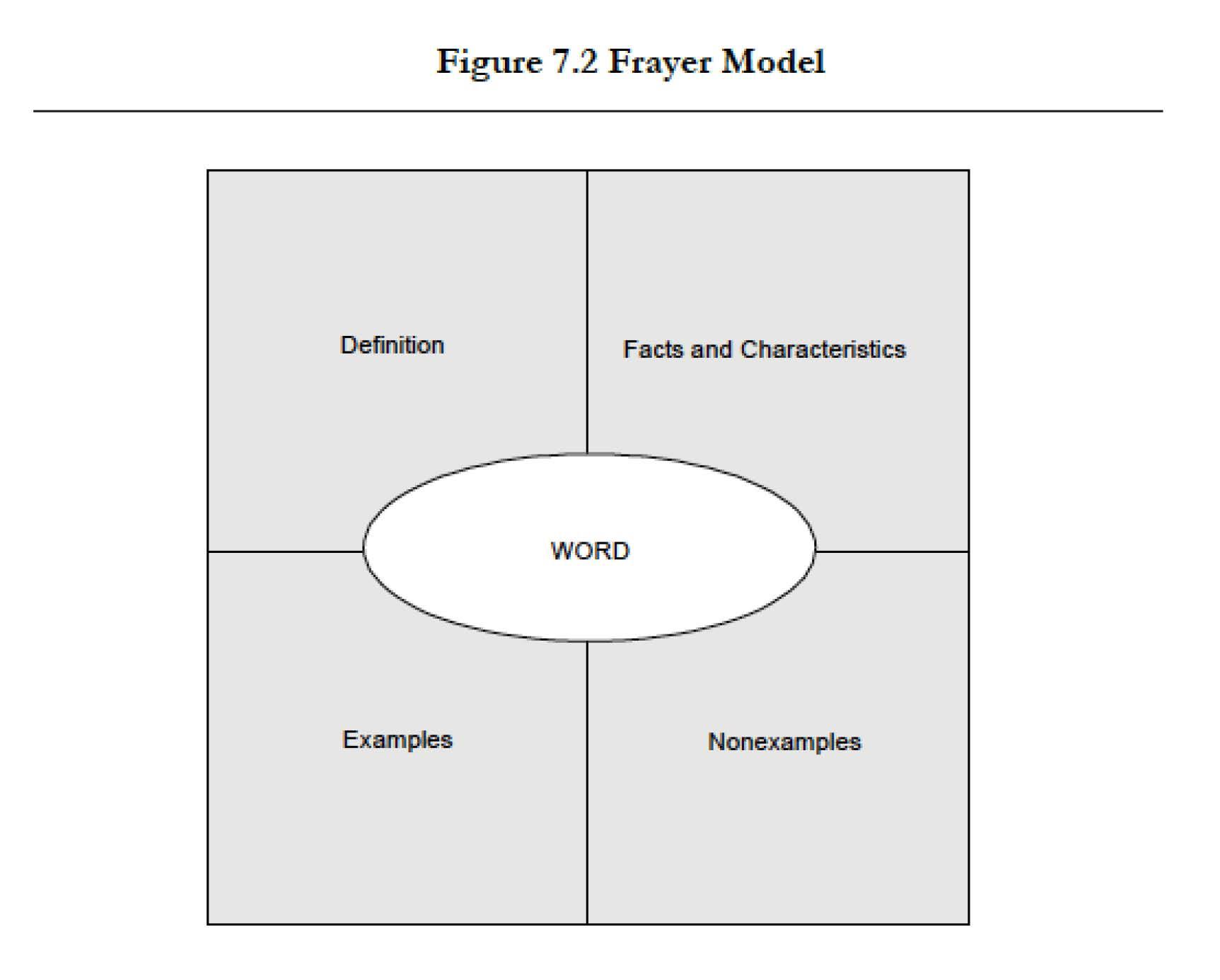
Deciding what words to teach, either directly or indirectly, is an important aspect of helping students develop vocabulary. Read the students' text closely yourself and call back nearly the following points:
- What words are critical to students' understanding of these texts?
- What words are they probable not to know?
- Which words should I teach them earlier reading (be cautious hither—don't rob them of the opportunity to practice learning words from context)?
- Which words tin can they learn past inferring from context?
- Which words nowadays the opportunity to teach word parts (prefixes, root words, suffixes)?
- Which words tin can just be mentioned and which should they store through a strategy for long‐term utilise?
- Which words can I apply to help students develop webs of discussion significant? (For example, teaching the word altered provides the opportunity to teach alternate and altercation.)
1 mode to teach vocabulary is through text-dependent questions. Teachers tin ask questions pertaining to vocabulary usage in text, and they can besides use vocabulary words in their questions.
Resources Downloads
Please log in to access the downloadable resource.

Academic And Domain Specific Vocabulary,
Source: https://eleducation.org/resources/teaching-academic-and-discipline-specific-vocabulary
Posted by: bellwased1993.blogspot.com
0 Response to "Academic And Domain Specific Vocabulary"
Post a Comment