

What Are Ancestors Regarded As
Retrieve when you got your AncestryDNA® test results? Y'all probable recall the anticipation, the excitement of what y'all might discover—and the fun of sharing your ethnicity guess results with family.
Simply what people oft don't realize is how much data is contained in their ethnicity estimate. An ethnicity estimate really has ii major pieces of information—ethnicity regions and communities. Nosotros are going to talk nigh ethnicity regions here.
Ethnicity regions are the virtually well-known part of the ethnicity guess and come with percentages, similar 25% Sweden or 10% Ivory Coast & Ghana.
They are really wide; they often cover one or more mod twenty-four hours countries. And they often reach back more xx generations.
Communities are the second piece of your AncestryDNA ethnicity gauge. Different ethnicity regions, communities are non assigned percentages. What they are is more precise areas of the world, to give you a more granular understanding of where your ancestors came from (sometimes downwards to the region of a country or fifty-fifty a county). And they're also from the more recent past, most 5-20 generations ago.
Here we are going to focus on the ethnicity regions.
How does AncestryDNA assign ethnicity regions in your ethnicity judge?
Assigning ethnicity regions based on your Dna sample is a complex process based on probability, statistics, shared DNA, and ongoing enquiry and science.
First our scientists create a reference panel, which is made upward of reference groups. Each reference group has the DNA of people whose family unit lived in a certain part of the world for many generations.
And each reference grouping represents an ethnicity region.
As of 2020, there were 70 reference groups in the AncestryDNA reference panel.
When a customer takes an AncestryDNA exam, our scientists compare their DNA, piece by piece, to come across which reference group each slice of that client'southward Deoxyribonucleic acid nearly closely resembles. The ethnicities assigned to each piece of DNA are so totaled upwardly and the percentages are calculated. If 15% of the DNA pieces analyzed wait most similar the France reference group, and so the customer gets xv% France in their ethnicity guess.
AncestryDNA continues to add samples and update its reference groups to better precision and include additional ethnicity regions in AncestryDNA test results. Additionally, AncestryDNA tin can update the way it analyzes your Deoxyribonucleic acid.
The updating of reference groups and the style the Dna is analyzed means that over time, your results may be updated likewise.
Snip, SNP
Here's a simplified instance of how the AncestryDNA algorithm assigns ethnicity regions. The algorithm looks at about 700,000 markers in your Dna sample. Those markers are called SNPs (pronounced snips). Each SNP refers to a certain position in human Deoxyribonucleic acid. And each SNP is made upwards of a pair of messages representing some combination of A, T, C, or G. Permit'due south say that at SNP rs122 in that location are two possibilities: A and T. Considering you lot get one letter (or allele) from each parent, y'all tin can take an AA, AT, or TT.
Each possible outcome at each SNP has a probability for how likely information technology is to show up in each region represented by the reference panel. We'll pretend that rs122 occurs in three populations—Indigenous Americas—Mexico, Sweden, and Scotland—at the following frequencies:
A = appears five% of the time in Indigenous Americas—Mexico populations, 75% in Swedish populations, and 80% in Scottish populations.
T = appears 95% of the time in Ethnic Americas—United mexican states populations, 25% in Swedish populations, and 20% in Scottish populations.
And so, if you have AA at rs122, it seems that that specific part of your Dna is more likely to be Swedish than Indigenous Americas—Mexico. If your Dna reads TT, the contrary seems more than probable. One SNP doesn't tell us much about your ethnicity, but when nosotros apply the same process to thousands of SNPs, then do the math, the grand total becomes the footing for your ethnicity estimate.
Why exercise ethnicity estimate percentages take a range and how is it determined?
In addition to the most probable gauge, our algorithm also generates 1,000 likely estimates using the probabilities learned from comparing your genetic data to our reference panel.
We use these one,000 likely estimates—which may be different from the well-nigh likely estimate—to figure out the range. The mode we calculate the range will depend on the region and the value of the most likely estimate.
Here's an instance of an AncestryDNA ethnicity estimate for someone with strong ties to Europe and the Americas.
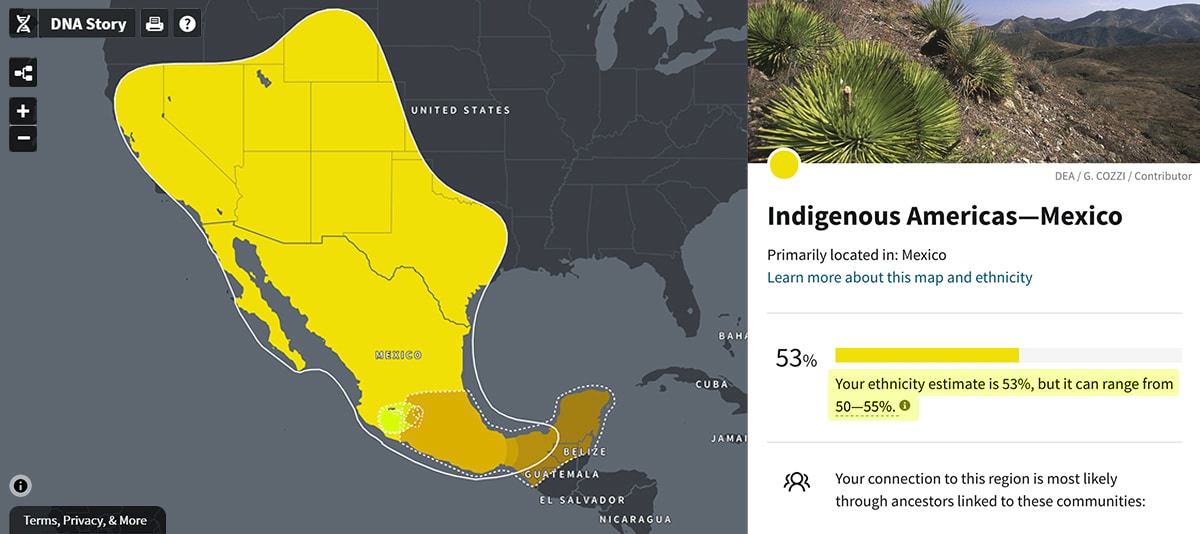
In the example above, between l% and 55% of this customer'southward Dna appears to match the Beginnings Ethnic Americas—Mexico reference panel, with an boilerplate percentage of 53%.
That 53% is the most likely number within a range of percentages that are as well likely. Less probable, simply non necessarily by much. To discover out your range of likely percentages, click on the ethnicity in your results that you are interested in.
These ranges are important to expect at, especially for results with lower percentages. In these cases, the range tin can sometimes include nothing. This means that for these results, it is possible that your ancestors didn't alive in that region or you didn't inherit whatsoever Dna from ancestors who did.
But My Family Never Lived in [Your Mystery Region Here]
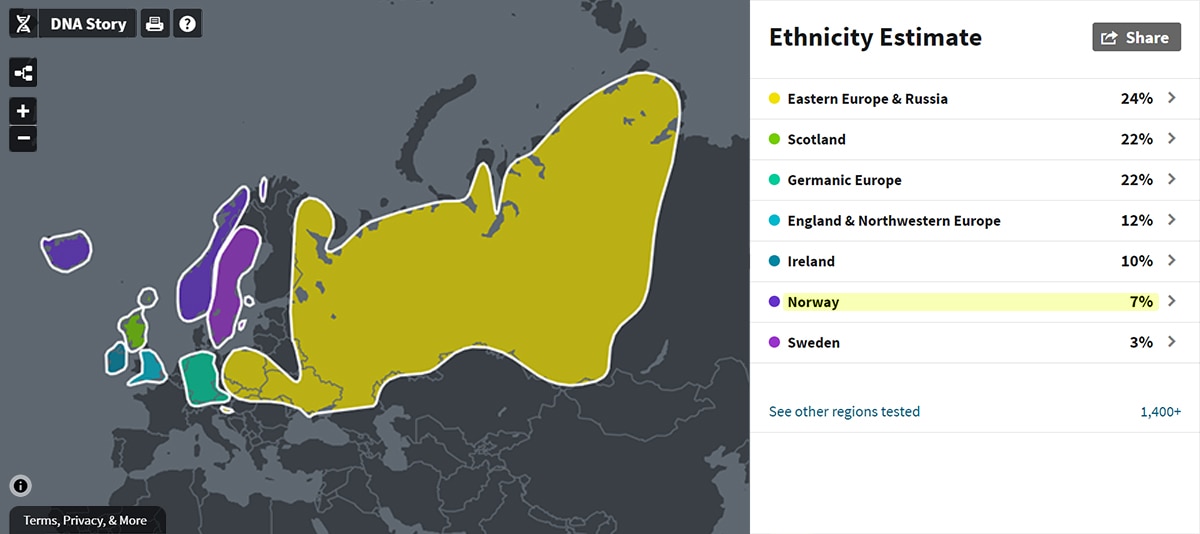
Here is an instance of someone with 7% Kingdom of norway in their results.
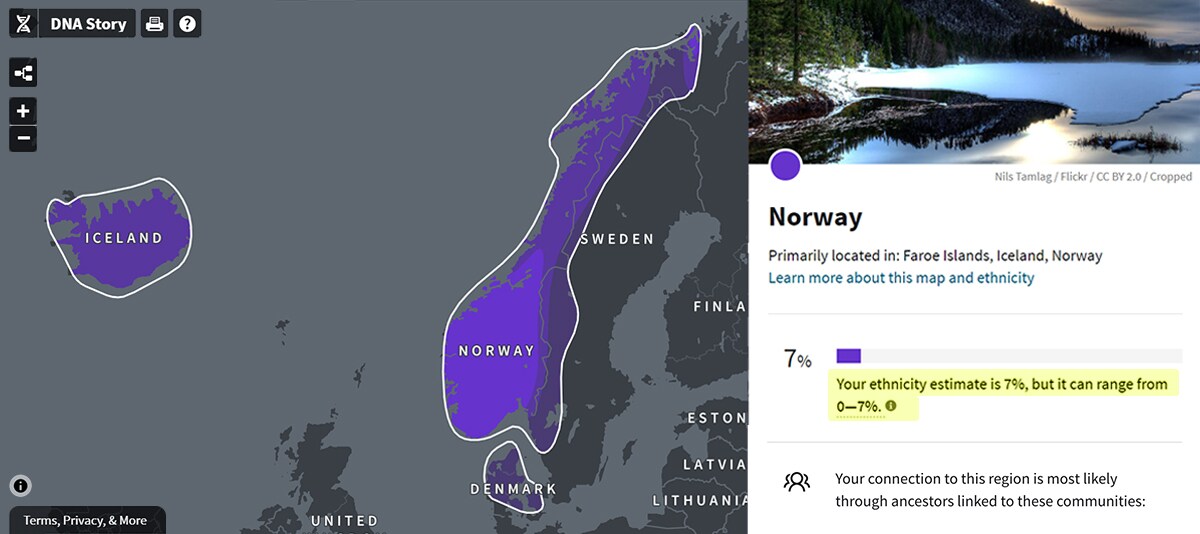
But what if they've never heard of everyone in the family unit being from Norway? This is where the maps and the polygons on them can assist. By clicking on Norway, the first thing that pops up is a note that this ethnicity is found primarily in Norway, Iceland, and Faroe Islands. OK, so already there are new possible places the ancestor who passed this down might be from.
And a close await at the map shows that other places are possible too—for example, Denmark and parts of Sweden.
This all makes sense when you consider that Norwegians, Swedes, and Danes all share a common Norse heritage. For centuries, hunter-gatherers pushed northward across the Baltic Bounding main, probing littoral fjords and inland stretches for farmable state. By the ninth and 10th centuries Norwegian Vikings colonized the Faroe Islands, Iceland, and Greenland (along with northern Scotland, the Orkneys, the Hebrides, and the Isle of mann).
So, your ethnicity estimate can provide insight not only on where your ancestors might take lived but too allow you to trace the path of your ancestors.
When Did All This Happen?
Your genetic ethnicity guess tells y'all about your possible historical origins, not necessarily about where yous live today. AncestryDNA genetic ethnicity estimates go back hundreds to more than a thousand years, when populations and their boundaries were often very different. This might lead to a different genetic ethnicity approximate than you might expect.
But while someone's linguistic communication, name, or culture may change when they motion to a new location, their Dna doesn't. This tin can lead to surprises in your genetic ethnicity. For instance, if the ancestors of your Italian ancestors migrated from Eastern Europe hundreds of years agone, you might show up as having Eastern European ethnicity instead of Italian.
The opposite tin can too happen. Dna is passed downwards randomly and the amount of DNA you might inherit from any particular ancestor decreases with each generation. That means you tin can accept an ethnicity y'all know of in your family history that doesn't show up in your ethnicity estimate.
If yous haven't looked at your ethnicity results in a while, become back and requite them another look. You're much more a pie chart and a handful of percentages. And so is your AncestryDNA ethnicity estimate.

What Are Ancestors Regarded As,
Source: https://www.ancestry.com/c/dna-learning-hub/reading-your-ethnicity-estimate
Posted by: bellwased1993.blogspot.com
0 Response to "What Are Ancestors Regarded As"
Post a Comment