

How To Fix The 4x4 On A Kawasaki Prairie
Disclosure: We may get commissions for purchases made through links in this post.
Among the most ingenious quads always produced by Kawasaki is the Prairie 400 four×4. This mid-sized ATV, launched in 1997, inverse the ATV landscape with its fully automatic CVT manual – laying out the foundation of standard rec-utility features in the process. Though short-lived, it earned the first "ATV of the Year Honor" inATV Mag and belonged to the about highly-regarded off-road vehicles during its heyday.
The Kawasaki Prairie 400 4×4 was the first recipient of the "ATV of the Year Award." Sporting industry-leading KAPS CVT manual, express-skid front end differential, and full-fourth dimension 4WD, this champ also prides itself on beingness the first fully automated quad offered by a Japanese manufacturer.
Because of pioneer wheelers similar the Prairie 400, off-roading hopefuls can at present grab beginner-friendly bikes to do on and bask the experience-dominated ATV scene once they have built enough confidence. Indeed, Kawasaki'due south introduction of its fully automatic transmission became a game-changer for many riders, as you will later on detect in this guide.
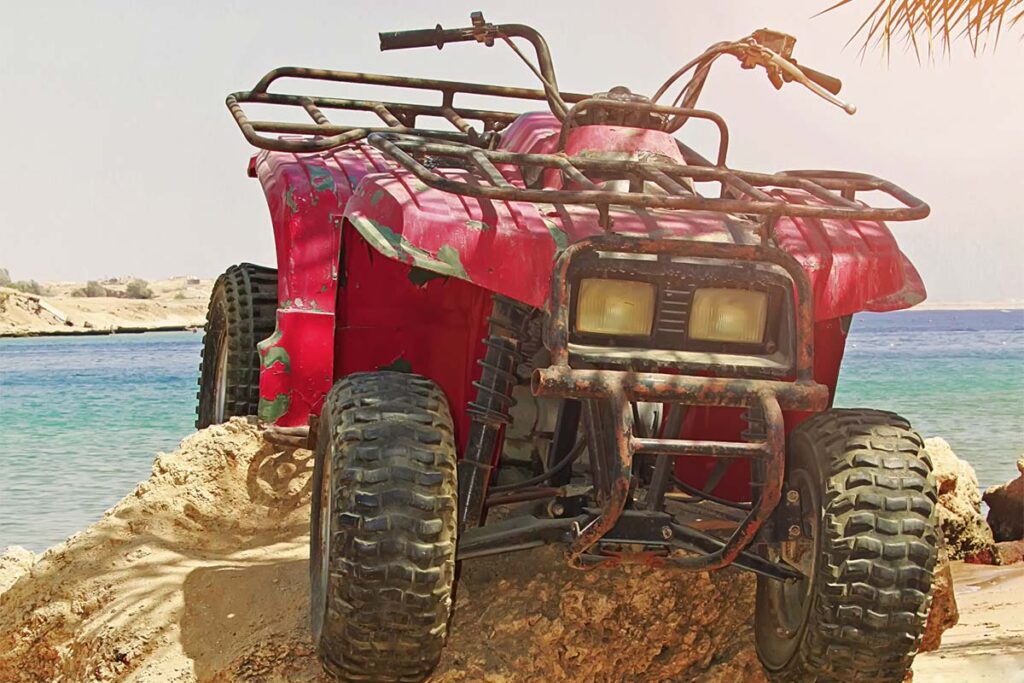
Squad Light-green's 1st Fully-Automatic ATV
While gear-driven ATVs are fun and simultaneously examination one's skill level on the road, they can be daunting – especially for nouveau and intermediate riders. Such was the sentiment of Kawasaki'southward visionary squad. These geniuses wanted to arrive at a ways for less-experienced riders to enjoy the outdoors without the scare of a transmission transmission.
But back then, powerful engines and adjustable gear ratios were the "in" thing. If Kawasaki were to provide newbies an option, information technology had to retrieve out of the box and create an ingenious product. Hence, the Kawasaki Prairie 400 4×4 was born.
Compared to Its Predecessors
In truth, aught much about the Prairie 400 was different compared to its predecessors. It had the same power mill as the 300- and 360-class machines and did not look any better in terms of styling. Information technology also did not accept fancy digital instrumentation. But what set information technology autonomously from the residue was that it was the first adult-sized fully automatic ATV from a Japanese manufacturer.
Paired with advanced features such as the all-new Kawasaki Automatic Power-Bulldoze System (KAPS), limited-slip front end differential, MacPherson Strut front break, and front end hydraulic disc brakes, the 400-class Prairie seemed like a friendlier, much more promising ride.
Years of Production
The Prairie 400 serial was produced for half-dozen years – from 1997 to 2002. During that catamenia, 11 models and iv trims were released to the market.
In its first year, the company introduced the 1997 Kawasaki Prairie 400 4×4, which foreseeably got awarded equally theATV Magazine's very first"ATV of the Twelvemonth."
In 1998, the sale of the 2WD version of the vehicle commenced.
In 1999, the bumped-up 4WD (KVF400-C) and 2WD (KVF400-D) trims hit the market place.
These later-yr models were the most feature-rich of the lot. They had improved KAPS, composite utility racks, aluminum wheels, a lighter-blazon DC accessory socket, and digital instrumentation (inclusive of a speedometer and odometer).
Kawasaki Prairie 400 Specs & Features
Engine
The Prairie 400 shares the same engine, cylinder arrangement, and lubrication system equally the Prairie 360 iv×4, making the one-time equally powerful and reliable. The compression ratio is slightly higher than the 360-class machine at 9.0:one, which eventually changed to 10.2:i for the 2000 model.
| Engine Blazon | iv-Stroke SOHC |
| Cylinder Arrangement | Unmarried cylinder |
| Carburetion System | Keihin CVK34 |
| Engine Cooling | Liquid cooling |
| Engine Fuel | Unleaded gasoline of at least Antiknock Index/PON 87 or RON 91, containing < 15% MTBE (Methyl Tertiary Butyl Ether)/TAME/ETBE, < 10% ethanol, or < 5% methanol w/ cosolvents & corrosion inhibitors |
| Fuel Capacity | 14 Fifty/3.7 US gal (reserve – three.6 L/0.95 Us gal) |
| Diameter x Stroke Ratio | 81×76 mm (3.19 x ii.99 inches) |
| Compression Ratio | ix.0:1 |
| Starting System | Electrical/recoil |
| Displacement | 391 cm³ / 23.9 in³ |
| Maximum Power | 29.6 hp/thirty PS (22.one kW) |
| Maximum Torque | 32.3 Nm (3.3 kgf-grand, 23.nine ft-lb) @ 5,500 RPM |
| Acme Speed | 50-60 mph (80.5-96.6 km/h) – owners' claim |
| Lubrication | Forced lubrication (wet sump) |
| Engine Oil & Quantity | 2.8 50 (three United states of america quarts) w/ filter; 3.one Fifty (3.iii Us quarts) west/out filter 3.four L (3.six U.s. quarts) of SAE 10W-40 w/ API grade of SJ meeting JASO T903 MA SAE 10W-30, 10W-50, 20W-twoscore, 20W-fifty – depending on ambient temperature |
Drivetrain
Although older Kawasaki vehicles already utilized a KAPS (Kawasaki Automatic Powerdrive System) V-belt converter, the Prairie 400 was the starting time of Team Greenish's four-wheelers to characteristic a fully automatic manual. This transmission upgrade enabled the 391-cmthree to have a considerably larger power and torque output versus same-category counterparts.
| Clutch | Wet shoe, automated, centrifugal type |
| Transmission Type | CVT w/ two-speed plus reverse, fully automatic |
| Bulldoze System | Shaft drive, 4WD/Belt bulldoze torque converter |
| Main Ratio | four.16-0.92 |
| Terminal Drive Ratio | 4.333 |
| Overall Drive Ratio | 43.807 – ix.688 (loftier); 61.736 – xiii.653 (low); 67.594 – 14.948 (opposite) |
| Transmission Gear Ratio | Loftier – 2.432; Depression – three.425; Reverse – 3.750 |
Ignition
The Kawie-exclusive KACR (Kawasaki Automatic Compression Release), paired with the four×4's electric-recoil starting arrangement, makes the Prairie 400 a highly preferred vehicle due to its ease of operation.
Furthermore, a DC receptacle constitute at the handlebar base and a trailer-type connector at the back of the machine ability up electronic accessories. When selecting add-ons to fit onto the quad, brand sure to not go over anything rated higher than 35W to prevent precipitous battery discharge.
| Ignition | Magneto DC-CDI |
| Ignition Timing | x° BTDC @ 1,300 RPM – 30° BTDC @ iv,300 RPM |
| Spark Plug, Gap | NGK DPR8EA-9 or ND X24EP-U9, 0.8-0.9 mm (0.032-0.036 inches) |
| Alternator Type | Stator magneto |
| Fuse | xxx Amp (principal); xv Amp (auxiliary, chugalug switch) |
| Battery | 12V 14 Ah, YTX14AH-BS battery formats |
| Bombardment Dimensions (50 10 West x H) | v.31 x 3.54×half-dozen.57 inches (134 ten 90 10 167 mm) |
Tires & Brakes
Wheel composition, tire size, and recommended tire pressure are the same between the Prairie 400 and 300 trims. Therefore, any same-sized tires or a slightly wider set ofCarlisle AT489 ATV Bias Tires (view on Amazon) volition work perfectly with your quad. All the same, you should note that when installing wheels, the rims are asymmetrical and should be installed but with the valve stems exterior of the vehicle.
| Front Tire, off-road/road air force per unit area | Dunlop KT121A AT25 ten viii-12, tubeless Tire Force per unit area: 35 kPa (0.35 kgf/cm2, 5 psi) |
| Rear Tire, off-road/road air pressure | Dunlop KT125 AT25 ten xi-10, tubeless Tire Pressure level: 28 kPa (0.28 kgf/cm2, 4 psi) |
| Front Brake Type | Dual hydraulic discs |
| Rear Restriction Blazon | Sealed drum brake |
Break
The frame and suspension arrangement of the Prairie series remained unchanged across all 300-course and college-displacement models. The front suspension is withal not-adjustable, somewhat limiting the handling characteristic of the wheeler.
| Frame Blazon | Tubular, double-cradle |
| Pulley, Trail | 2.five°, xv mm (0.59 inches) |
| Turning Radius | 3.ane grand (10.17 ft) |
| Front Break Blazon, Travel | MacPherson Strut, 170 mm (half dozen.7 inches) |
| Rear Suspension Type, Travel | Aluminum swingarm w/ 5-way adjustable spring preload, 180 mm (vii.1 inches) |
Dimensions
Except for pocket-sized differences in the vehicle'south overall dimensions, the Prairie 400 four×4 and its smaller-deportation siblings have the same combined rack, hitch tongue, and trailer weight capacities.
| Length | 2,065 mm (81.three inches) |
| Width | i,190 mm (46.ix inches) |
| Height | 1,145 mm (45.1 inches) |
| Seat Height (Unloaded) | 870 mm (34.2 inches) |
| Ground Clearance | 180 mm (seven.09 inches) – rear axle |
| Wheelbase | 1,250 mm (49.2 inches) |
| Track (F/R) | 880 mm (34.6 inches) / 890 mm (35.0 inches) |
| Dry out Weight | 274 Kg (604 lbs) |
| Carrier Capacity (F/R) | 88 lbs/154 lbs |
| Vehicle Load Capacity Limit | 205 Kg (452 lbs) |
| Hitch Tongue Weight | 40 Kg (88 lbs) |
| Trailer Weight (including cargo) | 499 Kg (1,100 lbs) |
Exterior
The earlier versions of the Prairie lineup were known to fall short on instrumentation – this includes the Kawasaki Prairie 400 iv×iv. Like other pre-2005 quads, the Prairie 400 did not have a speedometer until 1999.
Yous may go an OEM speedo similarGenuine Kawasaki Accessories Speedometer/Odometer (view on Amazon) if you accept a pre-2000 model and want to track your running mileage and hours. Just make sure to cheque your resources to verify parts compatibility.
| Speedometer/Trip Odometer | N/A |
| Indicator Lamps | Standard |
| Fuel Gauge | Standard |
| Engine Terminate Switch | Standard |
| Oil Temperature Switch | Northward/A |
| Headlight | Semi-sealed beam, 12V 25W/25W x 2 |
| Brake Light/Taillight | 12V 8W |
| Indicator Lights | (neutral, reverse) |
| Colors | Hunter/Woodsman Green, Firecracker Ruby |
Price of a Kawasaki Prairie 400
For your reference, I have consolidated the MSRP and retail values of all Kawasaki Prairie 400s released in the market place:
(Source:Nada Guides)
| Yr – Trim – Model Number **A/C trims – 4×4; B/D trims – 2×iv | List Cost | Retail/Merchandise-In Values |
|---|---|---|
| 1997 – 1998 Kawasaki Prairie 400 (KVF400-A1/A2) | $5,799 | $380 – $2,950 |
| 1998 Kawasaki Prairie KVF400-B1 | $5,199 | $240 – $2,350 |
| 1999 – 2001 Kawasaki Prairie KVF400-C1 to C3 | $six,099 | $495 – $iii,560 |
| 1999 -2001 Kawasaki Prairie KVF400-D1 to D3 | $five,199 | $470 – $3,690 |
| 2002 Kawasaki Prairie KVF400-C4 | $5,999 | $1,415 – $1,860 |
| 2002 Kawasaki Prairie KVF400-D4 | $four,999 | $i,330 – $ane,750 |
Units sold through dealerships or authorized resellers are oft in most-mint condition, thoroughly inspected, and with fresh Kawasaki Prairie 400 parts in some cases. Conversely, the overall condition of quads posted in auction listings is random.
You tin purchase a pre-loved 2000 Kawasaki Prairie 400 4×4 with minimal cosmetic damage and 4WD and reverse that works – if you are lucky. These rare finds may come equipped with a recovery winch, windshield, and (sometimes) fifty-fifty anOhio Steel Pro Grade Hybrid Tractor/ATV Cart (view on Amazon).
You may likewise end up with old units with a dead bombardment at best or those that need tranny work due to sipping gears. These listings fall betwixt $675 and $1,800.
Fixes to Common Problems
This section volition cover two of the all-time-known issues owners have with the Prairie 400.
Aquaphobic Chugalug
Despite its high-placed air intake, you should never be besides conceited in submerging your wheeler in deep water – even if you are accustomed to pulling off these stunts. Similar to other quads, the Prairie 400 has a fording depth limit, which is 9.0 inches.
Going beyond this height will either pb to a wet belt problem, drenched electrical components, or fuel contamination in the tank. Or water might enter your rear gear differential.
Cold-Blooded Wheeler
The Kawasaki Prairie 400 does not accept a V-Twin engine just ironically shares one major drawback with the Prairie 650 – that is, the machine can get challenging to commencement in cold weather. Like the big-diameter behemoth, the 400-grade engine somewhat retards the Prairie'south ignition, which results in a troublesome engine startup. In this situation, using the choke more frequently helps but only temporarily.
If you want to resolve the outcome permanently, you may need to audit the petcock valve and valve clearances to ensure your machine is not starved for fuel.
About Kawasaki
Kawasaki Heavy Industries, Ltd. is the maker of the Kawasaki Prairie 400 iv×4. Now a global name in multiple industries, the Japanese firm traces dorsum its history to 1878 when Shozo Kawasaki outset established his shipyard business aslope the Sumidagawa River in Tokyo.
Information technology wasn't until after that Kawasaki ventured into the ATV industry and released its first-ever ATC – the KLT200 – aslope the use of the "Team Green" name in racing competitions, production offerings, and other technological innovations.
Thanks to its rich technical background, Kawasaki develops high-quality shipping engines, transit, aerospace and energy systems, hydraulic mechanism, motorsport vehicles, and personal watercraft.
Decision – Kawasaki Prairie 400 4×4 Review
Even an off-road vehicle as rock-solid as the Kawasaki Prairie 400 has its fair share of flaws. Among them is the absence of selectable driveline modes (the quad operates on 4WD total fourth dimension), inadequate front end differential, and the lack of engine braking (the Prairie 400 series did not yet have the G-EBC™ in its design).
The skillful thing virtually this wheeler, still, is that its positive attributes outweigh its shortcomings. Its plush break, usable stock ability, unparalleled reliability, and affordable cost point are what Kawie riders remember about the quad.
Evolutionary changes washed to the Prairie 400 not only served the 4×iv itself only besides became instrumental in the development of new-and-improved Kawasaki off-road vehicles. Not a lot of ATVs can say the same for themselves.
More than its accolades and praiseworthy characteristics, this mean machine'southward contribution to the industry'southward growth is what truly makes information technology a standout – and why owning a Kawasaki Prairie 400 matters.

How To Fix The 4x4 On A Kawasaki Prairie,
Source: https://offroadingpro.com/kawasaki-prairie-400/
Posted by: bellwased1993.blogspot.com
0 Response to "How To Fix The 4x4 On A Kawasaki Prairie"
Post a Comment